

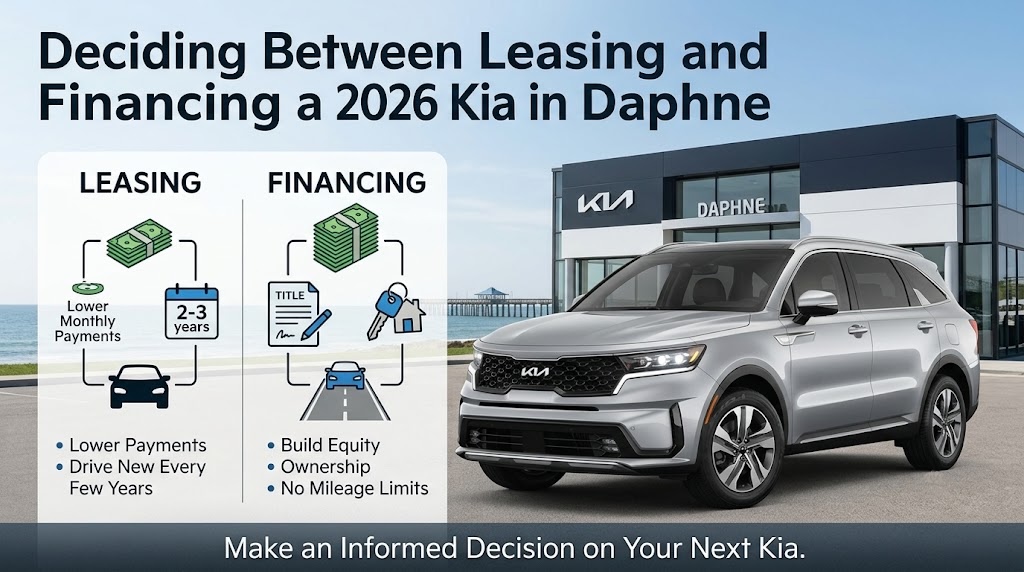
Deciding Between Leasing and Financing a 2026 Kia in Daphne
Leasing a 2026 Kia is usually better for drivers who want a newer vehicle more often, predictable mileage, and a lower short-term payment structure. Financing is usually better for drivers who want ownership, equity, unlimited mileage, and long-term control. At Kia of Daphne, we help shoppers compare both paths using real driving habits, trade value, credit application details, lease mileage needs, warranty coverage, and the specific Kia model they are considering.
Choosing between leasing and financing is not just a payment question. It is a lifestyle question. A Daphne commuter who drives predictable miles may like the flexibility of a lease. A Spanish Fort driver who crosses the Mobile Bayway every weekday may prefer financing because mileage can add up quickly. A Fairhope family planning to keep a Sorento, Carnival, Telluride, Sportage, or K4 for many years may value ownership more than a lower initial payment.
Our team can help you compare payment estimates, trade value, lease terms, available finance options, and current vehicle choices. You can start by reviewing our Kia financing options, using our payment calculator, or applying through our online pre-approval form. Final terms, APR, money factor, mileage allowance, approval, taxes, fees, availability, and offers can vary, so written contract details should always be reviewed before signing.
Leasing is an agreement to use a vehicle for a set number of months and miles. Financing is a loan used to purchase a vehicle over time. Leasing focuses on short-term use and turn-in options, while financing focuses on ownership, equity, and long-term flexibility.
Table of Contents
Main Difference Between Leasing and Financing
Key Takeaway: Leasing pays for vehicle use during a defined term, while financing pays toward vehicle ownership.
When you finance a 2026 Kia, your payments go toward purchasing the vehicle. Once the loan is paid off, you own the vehicle and can keep it, sell it, trade it, or continue driving without a monthly loan payment. That ownership path is why financing often works well for families and high-mileage drivers who want long-term value.
When you lease a 2026 Kia, you are paying to use the vehicle for an agreed term and mileage allowance. Kia Finance America notes that lease mileage is determined before the contract is signed, and that 12,000 to 15,000 miles per year is a typical range. Excess mileage can create additional charges, so mileage planning is one of the most important parts of any lease conversation.
The Consumer Financial Protection Bureau explains the distinction simply: buying means you own the vehicle once payments are made, while leasing is an agreement to use a vehicle for certain months and miles. That is why the best choice depends on how long you plan to keep the Kia, how much you drive, and whether you want to build equity.
| Decision Point | Leasing a 2026 Kia | Financing a 2026 Kia | Best For |
|---|---|---|---|
| Ownership | You use the vehicle during the lease term | You work toward owning the vehicle | Finance if ownership matters |
| Monthly Payment Structure | Often lower than financing the same vehicle, depending on terms | Often higher because the loan pays toward purchase | Lease for short-term payment focus; finance for long-term value |
| Mileage | Mileage allowance applies | No lease mileage cap | Finance for high-mileage driving |
| Customization | Limited by lease agreement | More freedom to add accessories or personalize | Finance if you plan to modify |
| End of Term | Return, buy, or choose another vehicle depending on contract | Keep, trade, sell, or refinance depending on situation | Lease for shorter cycles; finance for control |
| Ideal Use Case | Daphne driver with predictable mileage | Mobile commuter or long-term family owner | Choose based on mileage and ownership goals |
Based on Kia Finance America and CFPB guidance.
When Financing Usually Makes More Sense
Key Takeaway: Financing usually makes more sense if you drive a lot, plan to keep the vehicle, want equity, or need full control over use.
Financing is often the stronger path for drivers who plan to keep a Kia for five years or longer. Once the loan is paid, the vehicle can remain in your household without a monthly loan payment. You may also build equity over time, which can support a future trade-in or private sale.
High-mileage drivers should look closely at financing. If you drive from Spanish Fort to Mobile often, make frequent trips to Pensacola, or take regular Gulf Shores weekend drives, lease mileage limits may become a concern. Financing gives you the freedom to drive as much as needed without lease mileage charges.
Financing also makes sense if you want to personalize your Kia with accessories, carry pets and kids often, use the vehicle for sports gear, or avoid lease-end wear-and-tear reviews. You still need to maintain the vehicle, but you are not returning it under a lease condition inspection at the end of the term.
- Choose financing if you want to own your Kia.
- Choose financing if annual mileage is hard to predict.
- Choose financing if you plan to keep the vehicle beyond the loan term.
- Choose financing if you want to build possible trade-in equity.
- Choose financing if your family use may create normal wear over time.
When Leasing Usually Makes More Sense
Key Takeaway: Leasing usually makes more sense if you drive predictable mileage, want a newer Kia more often, and prefer a defined vehicle cycle.
Leasing can be a strong fit for shoppers who want to drive a new Kia every few years. If you like newer safety technology, updated infotainment, and fresh design cycles, leasing keeps you closer to the latest models. It can also help shoppers compare higher trims with a lower short-term payment structure than financing the same vehicle, depending on the lease terms.
A lease may work well for a Daphne driver with a consistent commute, a student or young professional with predictable mileage, or a family that wants to change vehicles as needs shift. It can also fit shoppers who want to drive under warranty during most or all of their lease term, depending on contract length and mileage.
The key is being realistic. If you expect to exceed the mileage allowance, modify the vehicle, or keep it for many years, financing may be cleaner. If you plan to return it and choose another Kia after the term, leasing may fit your routine better.
| Driver Profile | Lease Fit | Finance Fit | Our Recommendation |
|---|---|---|---|
| Predictable Daphne commuter | Strong | Also possible | Compare payment and mileage |
| High-mileage Mobile commuter | Riskier if mileage exceeds allowance | Strong | Start with financing |
| Family keeping vehicle long term | Less ideal | Strong | Finance for ownership |
| Tech-focused driver wanting new models often | Strong | Possible, but trade timing matters | Lease if mileage is predictable |
| Driver who wants accessories or customization | Limited | Strong | Finance if personalization matters |
| Best Overall Match | Shorter, predictable use | Longer, flexible ownership | Choose based on how you drive |
Based on Kia Finance America and CFPB guidance.
Lease Mileage, Fees, and End-of-Term Questions
Key Takeaway: A good lease decision depends on understanding mileage allowance, due-at-signing amount, acquisition fee, disposition fee, wear standards, and purchase option terms.
Lease ads can be useful, but the full contract matters more than the headline number. A lease may include a due-at-signing amount, first month’s payment, acquisition fee, taxes, title, registration, dealer fees, and other required charges. At the end of the lease, there may also be a disposition fee unless the contract or loyalty program says otherwise.
Wear-and-tear expectations also matter. A lease return inspection may review exterior damage, tires, glass, interior condition, missing equipment, and mileage. Normal use is expected, but excess wear can create additional charges. If your household includes young children, pets, sports gear, beach trips, or heavy cargo use, ask our team to explain lease-end standards before deciding.
Some drivers choose to buy their leased Kia at the end of the term. That can make sense if you like the vehicle, know its maintenance history, and the purchase option fits your budget. Ask about the residual value, purchase option fee, taxes, financing options, and timing before assuming a lease buyout is the best path.
| Lease Item | What It Means | Question to Ask |
|---|---|---|
| Mileage Allowance | Annual or total miles included in the lease | How many miles do I need per year? |
| Excess Mileage | Charges may apply if mileage exceeds the contract allowance | What is the per-mile charge? |
| Due at Signing | Amount paid at lease start | What is included in this amount? |
| Acquisition Fee | Lease setup fee from the leasing company | Is it paid upfront or included in payments? |
| Disposition Fee | Possible fee at lease return | When does it apply? |
| Purchase Option | Option to buy at lease end under contract terms | What is the buyout amount and fee? |
Daphne and Gulf Coast Driving Scenarios
Key Takeaway: Your annual mileage around Daphne, Mobile, Fairhope, Foley, Gulf Shores, and Pensacola can decide whether leasing or financing makes more sense.
Local driving patterns vary widely. A Daphne driver who mostly stays near home may fit a lease mileage plan easily. A Spanish Fort commuter crossing the Bayway daily may need the freedom of financing. A family driving between Fairhope, Foley, Gulf Shores, Orange Beach, and Pensacola may add more miles than expected during weekends and holidays.
We recommend estimating your annual mileage before you compare payments. Add work commute miles, school routes, sports travel, beach weekends, family trips, and holiday driving. If that number is close to or above a typical lease allowance, financing may be more comfortable.
| Local Driver | Driving Pattern | Lease vs Finance Fit | Why It Matters |
|---|---|---|---|
| Daphne commuter | Short, predictable daily routes | Lease or finance | Predictable mileage makes both possible |
| Spanish Fort to Mobile driver | Frequent Bayway and I-10 mileage | Finance | Higher annual mileage may challenge lease limits |
| Fairhope family | School, sports, errands, and weekend plans | Often finance | Family wear and changing mileage favor ownership |
| Gulf Shores weekend traveler | Beach trips, cargo, and longer routes | Finance or higher-mileage lease review | Extra miles can add up quickly |
| College grad or young professional | Predictable commute and newer tech preference | Lease or finance | Depends on mileage, credit, and ownership goals |
| Best Overall Step | Estimate annual miles first | Then compare payments | Mileage is often the deciding factor |
2026 Kia Models to Compare
Key Takeaway: The best payment path can change depending on the Kia model, trim, drivetrain, and how long you plan to keep it.
For a compact SUV shopper, leasing a 2026 Kia Sportage may make sense if the goal is newer technology every few years. Financing a 2026 Kia Sportage Hybrid may make sense if you drive a lot and want long-term efficiency. A family comparing three-row options may want to finance a 2026 Kia Sorento, 2026 Kia Sorento Hybrid, or 2026 Kia Carnival Hybrid if they plan to keep the vehicle through years of school, sports, and travel.
A sedan shopper may compare leasing and financing on the 2026 Kia K4 or 2026 Kia K5. A larger family may compare the latest Kia Telluride. Drivers interested in lower fuel use or electric driving can also review our EV and hybrid lineup.
We recommend choosing the vehicle first, then comparing payment paths. A lease on a higher trim may look attractive month to month, but financing may fit better if you want equity. A finance payment may be higher at first, but it can make more sense if you keep the Kia long after the loan term.
What to Ask Before Choosing
Key Takeaway: Ask for a side-by-side comparison that includes total costs, mileage, fees, trade value, warranty, and end-of-term options.
Before choosing a lease or finance plan, ask our team to walk through the full picture. The monthly payment is important, but it should not be the only detail. You should also review the term length, APR or money factor, due-at-signing amount, taxes, fees, trade value, mileage allowance, residual value, warranty coverage, and what happens at the end of the term.
If you have a trade-in, ask how the trade value affects each option. If you drive a lot, ask how much mileage the lease includes and what excess mileage costs. If you plan to keep the vehicle, ask what the payment looks like after different loan terms. If you want a lower payment now, ask how total cost changes over time.
- What is my total due at signing?
- What term length is being quoted?
- How many miles are included in the lease?
- What is the excess mileage charge?
- What fees apply at lease end?
- What is the purchase option price?
- How does my trade value affect lease vs finance?
- What warranty coverage applies during the term?
Leasing vs Financing FAQs
Is it better to lease or finance a 2026 Kia?
Leasing is usually better if you want a newer Kia every few years, drive predictable mileage, and prefer a defined term. Financing is usually better if you want ownership, equity, no lease mileage cap, and long-term control. The right choice depends on mileage, budget, credit, vehicle choice, trade value, and how long you plan to keep the Kia.
Does leasing a Kia build equity?
Regular lease payments generally do not build ownership equity because you are paying to use the vehicle during the lease term. Financing can build equity as the loan balance decreases and the vehicle retains value. A lease may include a purchase option, but that depends on the written contract.
How many miles can I drive on a Kia lease?
Lease mileage is chosen before signing the contract. Kia Finance America notes that 12,000 to 15,000 miles per year is typical, and that drivers may incur charges for excess mileage. Your exact allowance and per-mile charge will be listed in your lease agreement.
Can I buy my Kia at the end of the lease?
Many leases include a purchase option that allows you to buy the vehicle at the end of the term. The contract should list the residual value, purchase option terms, fees, and timing. If you like the Kia and know its maintenance history, a lease buyout may be worth comparing with a new lease or finance plan.
Is financing better for high-mileage drivers?
Financing is usually better for high-mileage drivers because there is no lease mileage cap. If you commute from Spanish Fort to Mobile, travel often around Alabama, or take frequent Gulf Coast road trips, financing may provide more flexibility and fewer end-of-term concerns.
Can I customize a leased Kia?
Customization on a leased Kia is limited by the lease agreement. Kia Finance America notes that lease customization is generally limited to approved accessories at lease start. If you want to add accessories, personalize the vehicle, or keep modifications long term, financing is usually the cleaner path.
What fees should I ask about before leasing?
Ask about acquisition fees, disposition fees, due-at-signing amount, taxes, registration, dealer fees, excess mileage charges, wear-and-tear standards, and purchase option fees. Lease terms can vary, so written contract details matter more than a headline payment.
Can I trade in my current vehicle when I lease or finance?
Yes. Trade value may be applied differently depending on whether you lease or finance, but it can help reduce the amount you need to cover. Our team can appraise your vehicle and show how the trade value affects each option before you choose.
Connect with us


 Warranties include 10-year/100,000-mile powertrain and 5-year/60,000-mile basic. All warranties and roadside assistance are limited. See retailer for warranty details.