

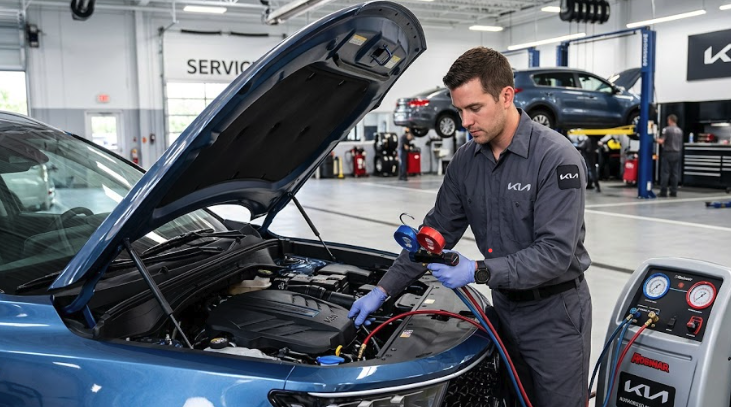
Kia A/C diagnostics and service help identify why your climate system is blowing warm air, producing weak airflow, creating musty odors, fogging the glass, cycling irregularly, or failing to cool the cabin during humid Gulf Coast weather. At Kia of Daphne, our service team focuses on the full A/C system, including vent temperature, airflow, cabin filter condition, refrigerant level, refrigerant type, system pressure, compressor operation, condenser condition, leak points, drain flow, sensors, controls, and electrical operation. If your cabin no longer feels cool, dry, and comfortable, the best next step is a focused A/C inspection rather than a general summer checklist.
Summer humidity around Daphne, Fairhope, Spanish Fort, Mobile, Foley, Gulf Shores, Orange Beach, Robertsdale, Loxley, Bay Minette, and Pensacola places real demand on your vehicle’s air conditioning system. The system is not only cooling air. It is also helping remove moisture from the cabin, support windshield clarity, and keep interior comfort stable while outside temperatures and humidity rise.
That is why A/C symptoms should not be ignored. Warm air, intermittent cooling, a musty smell, poor defogging, water inside the cabin, loud blower noise, or sudden airflow loss can all point to different causes. Some problems are simple, such as a dirty cabin air filter. Others require specialized equipment, such as refrigerant recovery, evacuation, leak detection, and precise recharge by weight.
This article stays focused on A/C diagnostics and service. We are not turning this into a broad summer maintenance list. Tires, batteries, oil changes, and wipers matter for vehicle care, but this guide is written specifically for drivers trying to understand climate control issues, cooling performance, refrigerant service, cabin airflow, and when to schedule A/C service at Kia of Daphne.
Quick Answer: Schedule Kia A/C diagnostics when the system blows warm air, cools only sometimes, has weak airflow, smells musty, makes unusual noises, fogs the glass, leaks water into the cabin, or stops cooling during humid weather. A proper A/C inspection checks airflow, vent temperature, cabin filter condition, refrigerant charge, system pressure, leak points, compressor operation, condenser condition, drain flow, and climate control operation.
Table of Contents
- Why Gulf Coast Humidity Makes A/C Diagnostics Important
- What a Kia A/C Diagnostic Service Checks
- Why Your Kia A/C May Blow Warm Air
- Weak Airflow, Cabin Filters, and Vent Performance
- Refrigerant Type, System Pressure, and Leak Testing
- Musty Vents, Evaporator Moisture, and Drain Concerns
- Foggy Glass, Defrost, and Cabin Humidity Symptoms
- Hybrid and EV A/C Diagnostic Notes
- When to Schedule A/C Service at Kia of Daphne
- Kia A/C Service FAQs
Why Gulf Coast Humidity Makes A/C Diagnostics Important
Key Takeaway: In Daphne-area humidity, your A/C system has to cool the cabin and remove moisture, so small problems can become noticeable quickly.
Heavy, moisture-laden air is part of summer driving near the bay. When the outdoor air feels thick and damp, your vehicle’s climate control system becomes the main barrier between a comfortable drive and a sticky, foggy cabin. A healthy A/C system helps cool the air, reduce cabin humidity, and keep the windshield clearer during hot, wet weather.
When the system is not working correctly, the symptoms can feel different from a simple “not cold enough” complaint. You might notice that the air starts cold and turns warm, the windshield fogs even with defrost selected, the cabin smells musty after the A/C starts, or the blower sounds loud while airflow still feels weak. Those symptoms point to different possible causes, which is why a diagnostic check matters.
Gulf Coast driving also gives the system fewer easy days. Short trips, stop-and-go traffic, high humidity, frequent rain, and long periods of A/C use can all make small weaknesses more obvious. A system that felt acceptable in spring may feel overwhelmed by July or August.
Our team approaches A/C service by looking at the symptom first, then testing the system that produces that symptom. Warm air may involve refrigerant charge, compressor operation, blend door function, condenser airflow, or an electrical issue. Weak airflow may involve the cabin air filter, blower motor, evaporator icing, or vent control. Musty vents may involve evaporator moisture or drain concerns. A focused diagnostic path helps avoid guessing.
| A/C Symptom | Possible A/C-Related Cause | Diagnostic Focus |
|---|---|---|
| Warm air from vents | Low refrigerant, compressor issue, system pressure concern, condenser restriction, control issue | Vent temperature, pressure readings, leak check, compressor command |
| Cold air at first, then warm | Evaporator icing, low charge, airflow restriction, sensor or control concern | Airflow, cabin filter, evaporator behavior, refrigerant charge |
| Weak airflow | Dirty cabin filter, blower concern, restricted evaporator, vent door issue | Cabin filter inspection, blower speed, air distribution |
| Musty odor | Moisture on evaporator, dirty filter, drain concern, microbial growth | Filter condition, evaporator area, drain flow, odor treatment need |
| Foggy windshield | Humidity control issue, A/C not dehumidifying, recirculation or defrost concern | Defrost function, A/C operation, humidity removal, air intake mode |
| Best next step | Focused A/C inspection | Diagnose the system before replacing parts |
What a Kia A/C Diagnostic Service Checks
Key Takeaway: A proper A/C diagnostic service checks performance, airflow, refrigerant condition, leak points, controls, electrical operation, and cabin comfort symptoms.
A/C diagnosis should be more precise than adding refrigerant and hoping for the best. If a system is low, there may be a leak. If airflow is weak, the problem may not be refrigerant at all. If the cabin smells musty, the concern may involve moisture and filtration. If the windshield keeps fogging, the system may not be removing humidity properly.
At Kia of Daphne, our A/C service process begins with your symptom. We want to know when the problem happens, how long it lasts, whether it changes with fan speed, whether it happens at idle or highway speed, and whether there are odors, noises, or fogging concerns. Those details help our technicians choose the right diagnostic path.
From there, the inspection can include vent temperature testing, blower operation checks, cabin air filter inspection, visual inspection of A/C lines and condenser, pressure testing, refrigerant recovery and recharge when needed, leak detection, drain inspection, electrical testing, and climate control function checks. The exact process depends on the symptom and the vehicle.
Kia owner information notes that low refrigerant reduces A/C performance and that overfilling also has a negative effect on the system. That is why refrigerant service needs to be measured and performed with proper equipment rather than treated as a quick top-off.
| Diagnostic Area | What We Check | Why It Matters |
|---|---|---|
| Customer symptom | Warm air, weak airflow, odor, fogging, noise, intermittent cooling | Guides the diagnostic process |
| Vent temperature | Temperature output at selected vents | Confirms actual cooling performance |
| Airflow | Fan speed, vent output, filter restriction, distribution modes | Separates airflow problems from refrigerant problems |
| Refrigerant system | Correct refrigerant type, amount, system pressure, leak concerns | Protects compressor and cooling performance |
| Compressor and condenser | Compressor operation, condenser airflow, visible damage or restriction | Supports heat transfer and pressure control |
| Cabin comfort | Humidity removal, defrost function, odor source, drain behavior | Restores cool, dry, comfortable cabin conditions |
Based on Kia owner manual guidance and Kia of Daphne service workflow.
Why Your Kia A/C May Blow Warm Air
Key Takeaway: Warm air can come from refrigerant level, compressor operation, condenser performance, electrical faults, or climate control issues, so diagnosis should happen before parts are replaced.
Warm air is the most obvious A/C complaint, but it has several possible causes. If the system is low on refrigerant, the A/C may not absorb and move heat properly. If the compressor is not operating correctly, the refrigerant may not circulate as needed. If the condenser is restricted or damaged, the system may struggle to release heat. If a control module, sensor, relay, fuse, blend door, or switch is not operating correctly, the system may not respond to driver input.
That is why our service advisors will ask whether the air is always warm, warm only at idle, cold at first and then warm, or cold on one side and warm on the other. Each pattern tells us something different. A system that cools at highway speed but not at idle may have a different issue than a system that never cools at all.
Low refrigerant also deserves careful attention because refrigerant should not simply disappear from a sealed system. If the charge is low, our technicians may need to locate the leak rather than only recharge the system. Leak points can include hoses, seals, service ports, condenser damage, evaporator concerns, or compressor-related areas.
A correct repair plan depends on measured results. The service team may need to recover refrigerant, measure the amount removed, inspect the system, perform leak detection, evacuate the system, recharge by the specified amount, and retest performance. That process protects the vehicle better than guesswork.
Weak Airflow, Cabin Filters, and Vent Performance
Key Takeaway: Weak airflow is often an airflow problem first, so the cabin air filter, blower motor, vents, and evaporator area should be checked before assuming the refrigerant is low.
Weak airflow can make a healthy cooling system feel broken. If air cannot move through the vents properly, the cabin will take longer to cool, the blower may sound louder, and the A/C may feel less effective during hot weather. In many cases, the cabin air filter is one of the first areas to inspect.
Kia owner information says the climate control air filter should be replaced according to the maintenance schedule, and if the vehicle is operated in severe conditions such as dusty or rough roads, more frequent inspections and changes may be required. A clogged filter can reduce airflow and place extra strain on the blower system.
Daphne-area driving can make filter condition important. Pollen, dust, road debris, moisture, and coastal humidity can all affect cabin air quality and airflow. If the filter becomes damp or dirty, the cabin may cool more slowly and may also develop odors.
Weak airflow is not always a filter issue, though. The blower motor, blower resistor or control module, vent doors, evaporator icing, or duct restrictions can also affect output. Our diagnostic process checks the likely causes in a logical order so we can recommend the right repair.
| Weak Airflow Clue | Possible Cause | What A/C Service Checks |
|---|---|---|
| Low airflow at all fan speeds | Cabin filter restriction or blower concern | Filter condition, blower operation, air intake path |
| Airflow changes by vent setting | Mode door or vent distribution issue | Climate control modes and vent operation |
| Blower is loud but air is weak | Restriction in filter, evaporator area, or duct path | Filter and airflow path inspection |
| Air starts strong, then fades | Possible evaporator icing or control issue | Temperature behavior, airflow change, refrigerant and sensor checks |
| Musty smell plus weak airflow | Dirty filter or damp evaporator area | Filter replacement and odor source inspection |
| Best next step | Airflow-focused A/C diagnostic | Check airflow before replacing cooling components |
Based on Kia owner manual guidance for climate control air filter replacement.
Refrigerant Type, System Pressure, and Leak Testing
Key Takeaway: Refrigerant service requires the correct type, correct amount, proper recovery equipment, and trained technicians because A/C systems operate under pressure.
Modern automotive A/C systems are sensitive to refrigerant type and amount. Kia owner information states that the actual refrigerant type and amount should be checked on the vehicle’s A/C refrigerant label. That label is typically located under the hood or inside the motor room area, depending on the vehicle.
This is important because different Kia vehicles and model years may use different refrigerants, lubricant specifications, and charge amounts. We do not recommend assuming the refrigerant type from a generic online chart. The correct approach is to verify the vehicle label and service information for the exact model and system.
Kia owner information also warns that vehicles equipped with R-1234yf use refrigerant that is mildly flammable and operates at high pressure, and that the A/C system should only be serviced by trained and certified technicians. The same official guidance notes that using the correct type and amount of refrigerant and oil is important, and that refrigerants should be reclaimed with proper equipment rather than vented.
If refrigerant is low, the cause must be found. Refrigerant does not get “used up” like gasoline. A low charge may indicate a leak, and recharging without leak testing can lead to repeated loss of cooling performance. Our technicians can inspect for visible signs, test pressure, use leak-detection methods, and recommend the correct repair before recharging the system by the specified amount.
| Refrigerant Service Step | Why It Matters | Customer Benefit |
|---|---|---|
| Check refrigerant label | Confirms refrigerant type, amount, and lubricant classification | Prevents incorrect service |
| Measure system performance | Identifies whether cooling is truly below expected range | Avoids unnecessary repairs |
| Recover refrigerant properly | Protects people, vehicle components, and the environment | Supports proper certified service |
| Inspect for leaks | Low refrigerant usually has a cause | Helps prevent repeat warm-air issues |
| Recharge by weight | Both low charge and overfill can hurt performance | Restores system operation correctly |
| Retest performance | Confirms cooling, pressure, and airflow after service | Gives the driver confidence before leaving |
Based on Kia owner manual refrigerant label and A/C service warnings.
Musty Vents, Evaporator Moisture, and Drain Concerns
Key Takeaway: A musty odor from the vents usually points to moisture, filter condition, evaporator area concerns, or drain issues, not a general maintenance problem.
A musty odor when the A/C first turns on is one of the most common humidity-related complaints. The evaporator is cold during operation, so moisture from the cabin air can condense on it. Normally, that moisture drains out of the vehicle through the condensate drain. In humid weather, the system may produce a noticeable amount of water underneath the vehicle, which can be normal.
Problems start when moisture stays where it should not. A dirty cabin filter, a damp filter, restricted airflow, or a drain concern can create conditions where odor-causing buildup develops. The result is a sour or musty smell that enters the cabin through the vents.
Our diagnostic process for musty vents can include cabin filter inspection, drain flow inspection, evaporator area evaluation, and odor treatment recommendations. If the filter is dirty, replacing it may be part of the solution. If the evaporator area needs treatment, our team can recommend a service designed for that concern.
It is also important to distinguish between normal condensation and a problem. Water dripping under the vehicle while the A/C is running can be normal. Water dripping into the passenger footwell, damp carpet, or a persistent mildew smell inside the cabin is different and should be inspected.
| Odor or Moisture Symptom | Likely A/C Area to Inspect | Recommended Service Path |
|---|---|---|
| Musty smell at startup | Cabin filter and evaporator area | Filter inspection and odor source evaluation |
| Weak airflow with odor | Filter restriction or damp filter | Replace filter if needed and inspect airflow path |
| Water under vehicle | Normal condensate drain operation | Usually normal if water is outside the cabin |
| Water inside cabin | Drain restriction or case concern | Inspect drain and evaporator housing |
| Odor returns quickly after cleaning | Moisture source not fully corrected | Check drain, airflow, and filter condition |
| Best next step | Odor-focused A/C diagnostic | Treat the cause, not just the smell |
Foggy Glass, Defrost, and Cabin Humidity Symptoms
Key Takeaway: Foggy glass during humid weather can mean the A/C system is not removing moisture properly or the climate controls are not directing air correctly.
In Gulf Coast humidity, visibility can change quickly. If your windshield fogs even when the defrost setting is selected, the A/C system may not be dehumidifying the air properly. It may also mean the air intake mode, temperature blend, blower output, or vent distribution is not operating as expected.
Modern climate systems often use A/C operation during defrost because dry air helps clear glass more effectively. If the A/C compressor is not operating, the refrigerant charge is incorrect, airflow is restricted, or the cabin filter is heavily clogged, defogging performance can suffer.
Fogging can also happen if recirculated cabin air holds too much moisture. Switching to fresh air can help in some conditions, but if the vehicle keeps fogging unexpectedly, the system should be inspected. A persistent fogging problem is a safety concern because it can reduce forward visibility during rain, night driving, or heavy traffic.
Our team can test defrost operation, A/C performance, air intake function, vent modes, cabin filter condition, and humidity-related symptoms. The goal is to restore a cabin that cools, dries, and clears the glass properly.
Hybrid and EV A/C Diagnostic Notes
Key Takeaway: Hybrid and EV climate systems may use electric A/C components, so diagnosis should be handled by technicians familiar with Kia system requirements.
Kia hybrid and electric vehicles can have climate systems that operate differently from traditional belt-driven setups. Some systems use electric compressors or integrated thermal management components that support cabin comfort and vehicle system temperature control. Because of that, diagnosis should be handled carefully and according to the exact vehicle’s service information.
If you drive a Kia hybrid or EV and notice weak cooling, reduced range during heavy A/C use, unusual climate system noises, or inconsistent pre-cooling, we recommend scheduling a focused A/C diagnostic visit. The service approach may involve high-voltage safety precautions, software checks, compressor command verification, temperature sensor review, or cooling system inspection depending on the model.
The important point is that hybrid and EV A/C concerns should not be treated like a generic recharge job. The system needs to be identified correctly, and the repair should follow Kia service information for the exact vehicle. That protects the climate system, electrical components, and overall vehicle performance.
Our advisors can help route the appointment properly when you tell us the model, symptom, and whether the problem happens during remote climate start, normal driving, charging, or after the vehicle has been parked in the sun.
When to Schedule A/C Service at Kia of Daphne
Key Takeaway: Schedule A/C service as soon as cooling performance, airflow, odor, noise, fogging, or water drainage changes noticeably.
Many A/C problems are easier to correct when they are caught early. A slightly weak system today can become a no-cooling complaint during the hottest part of the season. A small leak can lead to low refrigerant, poor compressor lubrication, and more expensive repairs. A clogged cabin filter can reduce airflow, strain the blower, and make the cabin feel damp.
We recommend scheduling A/C diagnostics if the system is not cooling like it used to, if one vent feels warmer than another, if airflow is weak, if the blower is noisy, if the cabin smells musty, if glass fogs unexpectedly, if water appears inside the cabin, or if the A/C cycles in a way that feels unusual.
When you schedule, tell us exactly what you are experiencing. “Warm at idle,” “cold for five minutes then warm,” “musty smell on startup,” and “foggy windshield in rain” are all more helpful than simply saying “A/C not working.” Clear symptom details help our technicians reproduce and diagnose the concern.
Our team can also review current service and parts specials, discuss genuine Kia parts when replacement is needed, and explain the inspection results before any repair work begins. The goal is straightforward: restore cool, dry, reliable cabin comfort for Daphne-area driving.
Kia A/C Service FAQs
Why is my Kia A/C blowing warm air?
Warm air can be caused by low refrigerant, a refrigerant leak, compressor operation concerns, condenser restriction, electrical issues, or climate control faults. A proper diagnostic check measures system performance before recommending parts or a recharge.
Can I just add refrigerant to my Kia A/C system?
We do not recommend guessing or topping off without diagnosis. Kia owner information notes that low refrigerant reduces A/C performance and that overfilling can also negatively affect the system. The correct refrigerant type and amount should be verified for the exact vehicle.
How do I know what refrigerant my Kia uses?
Kia owner information says the refrigerant type and amount can be found on the A/C refrigerant label located under the hood or inside the motor room area, depending on the vehicle. Our technicians verify the vehicle label and service information before performing refrigerant work.
Why does my Kia A/C smell musty?
A musty A/C smell usually comes from moisture in the evaporator area, a dirty or damp cabin air filter, poor airflow, or drain concerns. The service path may include cabin filter replacement, drain inspection, and odor treatment depending on the findings.
Is water dripping under my Kia normal when the A/C is running?
Yes, water dripping under the vehicle can be normal because the A/C system removes moisture from cabin air and drains condensation outside the vehicle. Water inside the cabin, wet carpet, or a persistent mildew smell should be inspected.
Why is my A/C airflow weak?
Weak airflow can come from a clogged cabin air filter, blower motor concern, vent door issue, evaporator icing, or an airflow restriction. The cabin filter is often one of the first items to inspect because it directly affects airflow through the climate system.
Why does my windshield fog even when I use defrost?
Fogging can happen when the climate system is not removing enough moisture, the A/C is not operating correctly, the air intake mode is wrong for the conditions, or airflow is restricted. Persistent fogging should be inspected because it can affect visibility.
Can a dirty cabin air filter affect A/C performance?
Yes. Kia owner information says the climate control air filter should be replaced according to the maintenance schedule and inspected more frequently under severe conditions. A dirty filter can reduce airflow and make the A/C feel weaker.
Do hybrid and EV Kia models need different A/C diagnostics?
They can. Hybrid and EV climate systems may use electric compressors or integrated thermal management components. Service should follow the exact vehicle’s Kia service information and may require technicians familiar with hybrid or EV system precautions.
When should I schedule A/C diagnostics?
Schedule A/C diagnostics when you notice warm air, weak airflow, musty odors, fogging, unusual noises, water inside the cabin, intermittent cooling, or reduced performance during hot and humid weather. Early diagnosis can help prevent more expensive repairs.
Connect with us


 Warranties include 10-year/100,000-mile powertrain and 5-year/60,000-mile basic. All warranties and roadside assistance are limited. See retailer for warranty details.